


Home - Arts & Entertainment REVIEW: 'Play With...
REVIEW: ‘Play With Time’ brought a nearly out-of-body sensation to audiences at Tanglewood’s Linde Center
"Play With Time" is poetic. It affords its audience an almost mesmerizing quality, similar to an out-of-body sensation.
Written by Barbara Wind
September 4, 2025
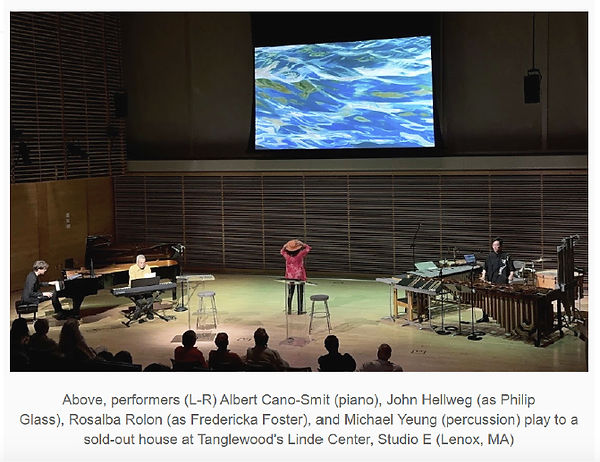
Bravo to Tanglewood for tackling the production of a new play, with music by Philip Glass. The world premiere of “Play With Time” by Eric Henry Sanders took place at Tanglewood’s Linde Center on August 23, 2025. Its premise is a conversation between two artists, a painter and a composer, evoking Samuel Beckett’s “Waiting for Godot.” (Glass wrote the music for Beckett’s play “Endgame.”) Sanders’ play is based on an actual conversation between composer Philip Glass and visual artist Fredericka Foster.

It is easy to understand why Glass, the distinguished and enormously prolific composer, is the recipient of numerous prestigious honors and awards. His brilliant and iconoclastic compositions hearken back to J.S. Bach and other composers of fugues. However, his massive output encompasses and embraces the world.
Born in Baltimore in 1937, Glass inherited his love of music from his father, a descendant of a long line of musicians. Glass was influenced by the great composers. He studied with and was encouraged by Nadia Boulanger. An inveterate arts explorer and iconoclast, he considers himself a classicist. In 1979, the musical genius who epitomizes contemporary music revealed, “The composers I studied with Boulanger are the people I still think about most—Bach and Mozart.”
That said, Glass is also inspired and influenced by many more modern musicians and composers, including Paul Simon, David Bowie, and Leonard Cohen, as well poets, playwrights, and visual artists from around the world. Interested in and seemingly open to everything, he has found inspiration in Albert Einstein, as well as Akhnaten, the only monotheistic Egyptian Pharaoh. Two of Glass’ more than 30 operas are based on those two historical figures.
“Play With Time” is a philosophical exploration of the creative process and how it is experienced and affected by time and memory. Playwright Eric Henry Sanders’ use of reiterative dialogue reflects Glass’ works in that he described himself as a composer of “music with repetitive structures.” “Play With Time” is poetic. It affords its audience an almost mesmerizing quality, similar to an out-of-body sensation. In that respect, it is a reflection of Philip Glass’ interest in and practice of Buddhism (which his fellow Jewish artists Leonard Cohen and Allen Ginsberg also shared).
The play’s transcendental quality was amplified by musical interludes of Glass’ compositions and scenes of Fosters’ paintings of water, as displayed in slides on a large screen. The highly accomplished actor John Hellweg was cast as Philip, with Rosalba Rolon as Fredericka. They performed these highly demanding roles with aplomb, as did the musicians. Pianist Albert Cano Smit and percussionist Michael Yeong provided the music. The play was directed by Donald T. Sanders (no relation to the playwright) in collaboration with music director Eve Wolf and set designer Vanessa James. Lighting designers Beverly Emmons and Carolyn Wong and musicians created a work of interest and import that brought the audience to its feet to cheer and applaud a fascinating new work that is destined to go places, including schools and museums, even outer space.


Play With Time
By Eric Henry Sanders
A production of The Massachusetts International Festival of the Arts (MIFA) in collaboration with Ensemble for the Romantic Century (ERC)
Directed by Donald T. Sanders
Music Director, Eve Wolf
Featuring John Hellweg as Philip Glass and Rosalba Rolón as Fredericka Foster
Pianist, Albert Cano Smit
Percussionist, Shiqi (Cover, Michael Yeung)
SYNOPSIS
Play With Time is inspired by a 2018 conversation between composer Philip Glass and visual artist Fredericka Foster, originally published in Nautilus magazine. Drawing on Glass’ signature reiterative compositional style, playwright Eric Henry Sanders crafts a lyrical duet between two living artists—a painter and a musician—that explores themes of time, memory, and the creative process. The performance integrates the music of Glass, performed live on piano and percussion.
Philip GLASS
(b.1937)
Mad Rush
Glassworks – II. Floe
Etude No. 7
Piano Etude No. 5
Perpetulum
Etude No. 3
Glassworks – I. Opening
Music for Voices
“Land of the Dead,” from The Screens
Etude No. 1
“Knee Play I,” from Einstein on the Beach
Metamorphosis 3
Mad Rush